Experience tells you where they’ve been. Readiness tells you where they can go.
Readiness Engine reads how leaders actually show up — in board updates, town halls, real work — and shows how they think, where their capacity sits today, and what would grow it. No test to game. A structured second perspective, alongside your own judgment — never in place of it.
Working With & Selected By
 Wildfire Labs
Far beyond surface-level personality tests — real, rigorous, research-backed insight into how a leader actually operates.

The most expensive guess in business is “they’ll grow into it.”
Every promotion, every succession call, every senior hire rests on the same unexamined bet: that performance in the last role predicts readiness for the next one. It doesn’t. The next level isn’t a bigger version of this one — it’s a different game entirely.
Most organizations run a rigorous process to find their most promising people… and then judge who’s actually grown on instinct, reputation, and tribal knowledge. That works at 70 employees. It quietly breaks at 700.
“You’re great in your role — so we’re now going to have you lead people doing that role. Totally different skill set. And organizations are just bad at assessing it.”
— HR leader, 3,500-person manufacturer
This is not a personality test.
Most leadership assessments ask people to describe themselves. Self-report is useful, but it is a rehearsal — and it measures preferences, not capacity. A person can tell you how they handle pressure. That is a different thing from watching how they actually handled it.
We read how a leader works through open-ended, unrehearsed situations: real calls, real memos, real decisions. There is no answer key to a board meeting that already happened. And because what we measure develops, the same read can be taken again — a second read shows what a year of deliberate practice actually changed.
What are we reading for? What drives people, how they believe the business should run, and how they think and act under pressure. We measure all three — then develop all three. Every company has untapped potential; we find it and build on it.
The result is not a label. It is a structured read of where someone stands today, and a path for where they can grow from there.
The numbers are the last place it shows up.
Organizational psychology moves first, customer experience follows, and financial results follow that. We measure the earliest link in that chain — the one that shows up in language months before it shows up in the numbers.
We read the work. Not a test.
Send us how a leader already shows up — recorded interviews, board updates, team meetings. Our engine reads the structure of how they think, relate, and hold pressure, and returns a clear developmental read:
Ready Now
The capacity for the next level is already present in how they work today. Make the bet with confidence — and give them the runway.
On the Path
The signals are emerging but not yet consistent. We name the specific gap — and the two or three moves most likely to close it.
Not Yet
The role would ask more than they can carry today. Better to know before the promotion than eighteen months after it — for them and for you.
Your talent review builds the shortlist. We’re the combine.
“Our process finds the promising people. What we’ve never had is the combine — the place you actually find out who’s ready for the bigger game.”
Every leader is somewhere on the climb.
Development isn’t a ladder of job titles — it’s a climb in how much world someone can see and carry. Keep scrolling.
Mastering what’s in front of you
Today’s work, today’s risks, today’s needs. Most careers — and most promotions — are decided here.
Seeing patterns, not just tasks
Climb, and you start seeing past the next ridge. Systems come into focus.
Complexity compounds
More options, more tradeoffs, more responsibility. This is where the next level actually lives.
Blind spots become visible
Some perspectives only make sense from higher ground. No skill training substitutes for altitude.
Each ridge reveals another horizon
Readiness isn’t a finish line — it’s knowing where someone is, and what the next level asks.
Back to earth, carrying it all
Using everything the climb gave you. Practical. Grounded. Ready to return — and lead.
Mastering what’s in front of you
Today’s work, today’s risks, today’s needs. Most careers — and most promotions — are decided here.
Seeing patterns, not just tasks
Climb, and you start seeing past the next ridge. Systems come into focus.
Complexity compounds
More options, more tradeoffs, more responsibility. This is where the next level actually lives.
Blind spots become visible
Some perspectives only make sense from higher ground. No skill training substitutes for altitude.
Each ridge reveals another horizon
Readiness isn’t a finish line — it’s knowing where someone is, and what the next level asks.
Back to earth, carrying it all
Using everything the climb gave you. Practical. Grounded. Ready to return — and lead.
Skills grow sideways.
Capacity grows up.
Forty years of developmental research shows two different kinds of growth — and almost every assessment on the market only measures one of them.
More skill — what most tools measure
More skill at the same altitude
Training, certifications, personality type, technical mastery. Valuable — but it makes someone better at the game they’re already playing. It can’t tell you if they’re ready for a bigger one.
More capacity — what we measure
Capacity for a more complex game
How many perspectives someone can hold at once. Whether pressure sharpens them or contracts them. Whether their team tells them the truth. This is what the next level actually demands — and it’s measurable in how people speak and work.
From the valley, the ridge hides everything behind it. From higher ground, the same landscape shows you more — nothing changed but the vantage. Capacity grows the same way: development keeps opening new lines of sight through adulthood, and where a leader stands on that climb shapes how much complexity they can carry.
Grounded in five decades of peer-reviewed adult development research — the field calls these two kinds of growth horizontal and vertical development. Your team can just call it skill vs. capacity. Measured from real language, in real work — there’s no answer key to study, and polished delivery doesn’t move the score.
Read the full methodology — how we measure complexity →The science and the capital — in the same room.
An instrument that reads leadership is only as trustworthy as the people who built it. Ours spent their careers on both sides of the table it now serves.

Benji Whitehurst
Co-Founder & CTO
Twenty years inside the adult-development science the engine measures — and a career training the relational layer it reads.

Logan Yonavjak
Co-Founder & CEO
Two decades moving capital into what matters — the exact PE, CEO, and LP rooms this instrument serves. Yale MBA.
Ashby Monk
Founding Advisor & Investor
Stanford professor, Executive Director of the Long-Term Investing research center — and our first check.
Six questions every senior decision quietly depends on.
No jargon, no acronyms — six dimensions of readiness, each read from how the leader actually operates.
Three steps, from the work leaders already do.
Share the real work
A recorded 45-minute guided interview — or the recordings you already have: board updates, all-hands, executive interviews. The data is sharper because nobody performed for it.
The engine reads the structure
Not keywords — structure. How many perspectives held at once, how pressure is processed, how feedback lands. AI-assisted and human-anchored — human reviewers add a second layer at higher service tiers.
Get the read — and the path
Ready Now, On the Path, or Not Yet — with the two or three highest-leverage moves that change the answer. The assessment is the doorway. The development is the point.
What this doesn’t tell you — on purpose
Readiness isn’t a verdict on a person, and it’s never the only input. Skills, context, and your own judgment still matter. We’re one instrument in the room — the one that reads what interviews can’t.
A living map of capacity — not a score in a drawer.
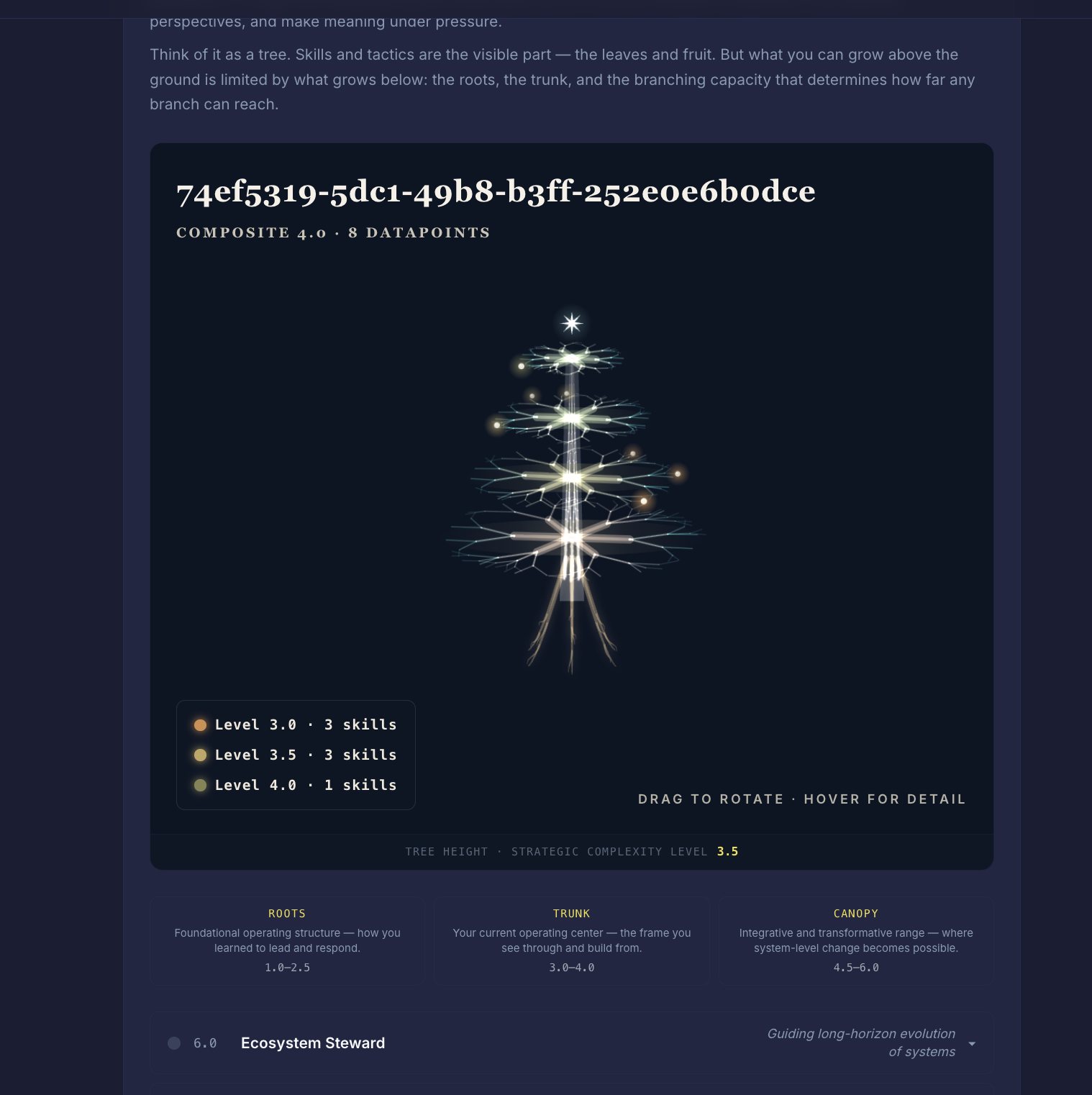
Every skill, anchored to evidence. Each capability the engine finds is tied to a specific moment in the leader’s own words — nothing generic, nothing hand-waved.
Levels you can see. The readiness graph maps where capacity is rooted, where it’s growing, and where the next branch is forming. Drag to rotate. Hover for detail.
It grows with the leader. Reassess after six months and watch the map change. Development you can point to in a board meeting.
The Signal Stack
Personality is the ground floor. Behavior is the frame. Readiness lives above.
Developmental readiness
The vertical read — capacity for complexity, growth trajectory, and what the next level asks. The layer no other instrument measures.
Readiness EngineBehavioral analytics
How people actually operate — behavioral signal grounded in a decade-plus of structured interview data, through our partnership with MiliMatch.
Partner · MiliMatchPersonality attributes
The Big 5 — psychology’s most validated trait model. The stable baseline every deeper read is anchored against.
Big 5 ModelThree ideas, animated — from our co-founder’s sketchbook
The Climb
Why the next level is a different game — not a bigger version of this one.
Watch it move ↗Explainer1:24Vertical Development
From Main Street to skyline — how capacity builds new floors on the same foundation.
Watch it move ↗Explainer0:38Exponential Change
The world is compounding. Leadership capacity has to compound with it.
Watch it move ↗The read, in their words.
I’m a certified coach and I’ve taken many assessments. Most cover broad personality traits in careful, blurry language — ‘this can be good, but…’ This was different: three concrete levers instead of twenty vague insights, practical recommendations, and honest, critical feedback. Focused and deep.
Founder risk is often invisible, yet it’s one of the top reasons startups fail. The Readiness Engine makes that risk measurable and actionable — exactly what our ecosystem needs.

The Readiness Engine marks such an important shift. Founders are often the make-or-break factor, yet so much of the assessment still relies on gut feel.

I’m excited to see tools like the Founder Readiness Level emerging — assessments that speak directly to the startup experience.

Built for the people carrying decisions that can’t be taken back.
Scaling Companies
The promotion you can’t afford to get wrong
You’re growing from 70 to 700. Tribal knowledge stopped scaling a hundred hires ago. Know who’s ready before you make the bet.
Boards & CEOs
The succession you only get one shot at
A structured, evidence-anchored read on every internal candidate — built to be defended in the boardroom, not just felt in the gut.
Investors
The founder you’re about to back
The deck tells you the market. The data room tells you the numbers. We tell you whether the founder can grow as fast as the plan.
Coaches
The instrument your practice deserves
Your training gave you the philosophy. We give you the instrument — a shared map, a measurable baseline, and visible movement over time.
Why We Exist
The world doesn’t need more leaders.
It needs leaders ready for it.
Built on informed consent. No placement incentive, no conflicts of interest. Trust & Ethics →
Develop, don’t gatekeep
Every read comes with a path forward. Formative, not summative — the measurement itself develops the leader.
Honest by design
We tell you what we can measure, what we can’t, and where human judgment still owns the call. Precision is part of the brand.
Globally inclusive
Built to read capacity across cultures and communication styles — not to reward whoever sounds most like the last generation of leaders.
Asked by buyers like you. Answered without adjectives.
Is this just another assessment that oversells and under-delivers?
Most tools in that drawer are self-report — people rating themselves, gameable on day one, parked in a folder after the offsite. Readiness Engine reads real work product, feeds live decisions (succession, development, readiness), and starts a development arc rather than ending with a report. Judge it by mechanism, not adjectives — the methodology overview is public.
Can someone game it?
There’s nothing to study for. No questionnaire, no answer key — the engine reads the complexity of reasoning in open-ended, real-world communication. Polished delivery doesn’t move the score; the structure of the thinking does.
How do I know it predicts anything?
The read describes present capacity — how a leader handles complexity today. On validation: we’re correlating reads against the Big Five and MiliMatch’s validated behavioral analytics, plus tracking outcomes in pilots, and we publish results as they land. Fastest personal proof: the calibration read.
Will it tell me anything my own judgment doesn’t?
Maybe not — some people are exceptional readers of others. That’s testable in an hour: pick the leader you know best and compare our blind read to yours. What most people find is one thing they sensed but couldn’t structure or defend — which is exactly the piece that matters when the call is contested.
Is this used to decide who gets hired or promoted?
No — and it shouldn’t be. Readiness Engine is a developmental instrument: it informs those decisions alongside your judgment and everything else you know, and it never makes them. Every profile pairs the read with a development pathway — the point is to grow the bench, not gatekeep it.
Can I see how it works before trusting it?
Yes. The methodology overview covers what goes in, what the six capacities mean, and how the dual-axis scoring works. (The scoring rubric itself is proprietary — as with any validated instrument — but the reasoning is open to inspection.)
The Calibration Read
Skeptical? Good. Test us on the leader you know best.
Pick someone you know inside and out — strengths, blind spots, how they hold up when it’s hard. We read them blind, from one short interview or recordings you already have. Then you put our read next to everything you know.
If we only tell you what you already knew, you’ve spent an hour. If we surface the thing you knew but couldn’t articulate — the thing you couldn’t defend to a board — you’ll know exactly what this instrument is for.
- Rooke, D. & Torbert, W. (2005). Seven Transformations of Leadership. Harvard Business Review. Leaders at higher developmental stages produce ~3× more sustained organisational transformation. ↗
- Leadership IQ (2005). Why New Hires Fail. 46% of new senior hires fail within 18 months — 89% due to interpersonal and attitudinal factors, not skills. ↗
- Wasserman, N. (2008). The Founder’s Dilemmas. Harvard Business Review. The majority of startup failures trace to people problems, not product. ↗